
Generative Al Vs Agentic Al | What is the Difference?
Artificial intelligence is no longer an experiment; it is already an important component of modern business transformation. As businesses aim for rapid delivery cycles, improved decision-making, and robust operations, Generative AI (GenAI) and Agentic AI have emerged as strong technologies that will significantly change the way businesses operate.
In today’s competitive world, speed itself is insufficient. Speed without understanding leads to inefficiency, redundant work, and higher risks. Enterprises now require technologies that can move effortlessly and think intelligently. This is where GenAI and Agentic AI play an essential role—helping enterprises produce rapid results while maintaining accuracy, quality, and strategic control across complex operations.
What Is Generative AI?
Generative AI refers to AI systems which are capable of creating new content such as text, code, images, insights, and structured outputs by learning patterns from large datasets. Unlike traditional AI models that primarily focus on prediction or classification, GenAI is designed to generate outputs aligned with human intent.
In enterprise environments, Generative AI acts as a powerful productivity multiplier by supporting knowledge work at scale.
Examples of Generative AI:
- Content and documentation generation
- Marketing Campaign Content Creation
- Financial Reporting Data
- Code assistance and debugging
- Conversational customer support
- Data analysis and reporting
- Software testing and quality acceleration
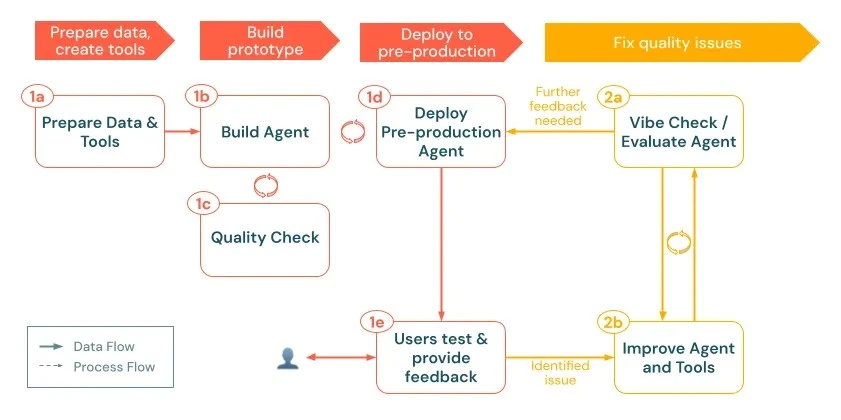
Work Flow of Generative AI
What Is Agentic AI?
Agentic AI focuses on action, whereas Generative AI focuses on creation.
Agentic AI systems are intended to recognize broad objectives, break them down into actionable stages, interact with different resources or systems, evaluate outcomes, and adjust their behavior gradually. These systems function with more freedom, allowing them to manage workflows from start to finish with little human involvement.
In business environments, Agentic AI functions like a digital operator which can coordinate processes, monitor performance, handle exceptions, and continuously improve outcomes. Instead of responding to isolated prompts, Agentic AI works persistently toward defined objectives.
Examples of Agentic AI
- Automated Customer Support Agent
- Smart Investment Assistant
- AI IT Operations Agent
- Autonomous Inventory Management System
- Automated Fraud Detection & Response
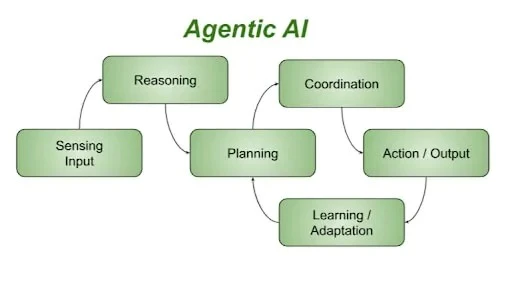
Work Flow of Agentic AI
Real-World Enterprise Use Cases
Software Development and Quality Engineering
GenAI increases code production, testing, and documentation. Agentic AI expands on this by tracking modification to code, updating test frameworks, running regression tests, and highlighting risks early, resulting in quicker and more reliable deployments.
Customer Support and Experience
GenAI provides interactive chatbots with human-like responses. Agentic AI enhances this capabilities by handling issues from start to finish, generating active follow-ups, and continually learning from customer interactions, resulting in increased efficiency and satisfaction.
Data Analytics and Decision Support
GenAI summarizes reports and detects trends in complicated datasets. Agentic AI continually monitors KPIs, gives alarms, and recommends or in some cases executes the required actions, allowing enterprises to shift from responsive to predictive decision-making.
Data Visualization and Business Intelligence Dashboards
GenAI improves dashboards by providing organic insights, analysis, and explanations based on visual data. Agentic AI constantly tracks dashboards, recognizes variations or patterns, and automatically generates alerts or actions, converting static displays into intelligent, decision-driven analytical systems.
Business Process Automation
In finance, human resources, and operations, Agentic AI can automatically perform validations, approvals, and identification of errors. GenAI enhances this by creating explanations, summaries, and records of audits that increase transparency and safety.
Why Businesses Are Adopting These Technologies
The purpose of GenAI and Agentic AI is Augmentation, not replacement. Organizations adopt these technologies to:
- Increase operational efficiency: Teams generate quicker results while maintaining quality by automating routine tasks through business AI automation.
- Improve accuracy and consistency: AI-driven implementation reduces human error while ensuring consistent performance across diverse corporate systems.
- Enhance lead generation and customer outreach: AI-powered systems detect potential customers, produce targeted promotions, and automatically send notifications, messages, or demo calls, allowing sales teams to contact the correct customers at the ideal time.
- Scale without proportional headcount growth: Intelligent automation technologies offer business growth while keeping operating expenses in balance.
- Employees can concentrate on essential areas like: innovation, decision-making, and long-term company performance while Generative AI can manage the execution of heavy tasks.
They work together to create advanced intelligent automation systems that understand context, function self-sufficiently and improve over time.
Limitations and Considerations
- Dependence on high-quality data: Poor or biased datasets can directly impact Generative AI accuracy and enterprise reliability.
- Limited contextual understanding: Even advanced Agentic AI systems require human guidance for nuanced and domain-specific decisions.
- Understanding issues associated with compliance: Enterprises must assure AI transparency, auditability, and regulatory alignment.
- Security and over-automation risks: Unsupervised AI-driven automation can bring operational and cybersecurity concerns.
Human supervision remains essential for guaranteeing secure, appropriate, and ethical corporate implementation of AI.
The Bigger Picture
Generative AI and Agentic AI describe the transformation from simple automation to intelligent human–machine collaboration. They have changed software development, interaction with customers, data analysis, and operations across various industries.
The real difference is not the technology itself, but how effectively businesses implement it. AI can produce and perform but humans decide direction, goal, and effect.